Chris Mitchell sees the American premiere of
I Shot Andy Warhol
The debut feature from writer-director Mary Harron, which opened in New York last month, takes a hitherto unexamined angle on the Warhol myth. I Shot Andy Warhol tells the story of Valerie Solanis, Warhol's would-be assassin and author of the S.C.U.M. (Society for Cutting Up Men) manifesto. Focusing mainly on the couple of years leading up to the shooting in June 1968, the film makes deft use of flashbacks and wry soliloquies from Solanis to trace the genesis of her theory that man is only a biological accident. Whether amongst the high-life Factory crowd or prostituting herself on the street, Solanis finds plenty of case-studies to support her idea. The lack of recognition from the Factory crowd for her creative talents, exacerbated by her extreme poverty, drives Valerie to seek power through other means...
Originally conceived as a TV documentary-drama, I Shot Andy Warhol has the same sort of low-budget atmosphere. This works against the film during the Factory scenes, where the attempt to depict outrageous decadence looks distinctly tame. Jared Harris' performance as Warhol also falls victim to the film's documentary approach. Warhol is still very much a visual icon and subsequently any actor trying to play him has to reproduce Warhol's presence, not just his speech patterns. Harris does the latter brilliantly, but fails to make the audience suspend their disbelief.
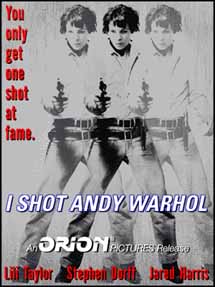
It is precisely the relative visual anonymity of Valerie Solanis that allows Lili Taylor to fully take on her persona. She gives an excellent performance, harsh, humorous and streetwise, particularly when sharing the screen with Stephen Dorff's wonderfully diva-esque portrayal of the transsexual Candy Darling. The unlikely, amusing friendship between Solanis and Candy points to the fundamental paradox of Solanis' character - for all of her theoretical hatred of men, Solanis is continually seen striking up friendships with them. At one point Solanis conducts an audition for her new play in an alley, telling the hopeful actor, "Don't worry, I'm not going to mug you, it's just bad for my image to be seen with you."
This is also the major problem of the film, because there is no real reason given for why Valerie shot Warhol at all, except for her frustration that he wouldn't produce her play (characteristically entitled Up Your Ass.) This seems more motivated by petulance rather than hatred or rage. Worse, the film makes no attempt to examine the aftermath of the shooting, either for Solanis or Warhol. It is left to the end credits to point to something darker beyond the film's feisty portrayal of Solanis; a brief caption notes that after the shooting, Valerie spent three years in jail followed by six years in and out of mental hospitals. She died in 1988. I Shot Andy Warhol certainly portrays Valerie Solanis as "a gritty, ragtag feminist too far out for Warhol" (New York Times) - but it seems as if the real story begins after the film's conclusion. Those of you who are intrigued by the Warhol myth will probably find this film worthwhile - but while it finally gives centre stage to the shadowy Valerie Solanis, it prompts as many questions as it gives answers.
{ 1 comment… read it below or add one }
http://www.myandywarhol.com
terrific site to catch video’s, articles and statements about ‘Double Denied’ joe simon’s battle with the Andy Warhol Art Authentication Board.
The controversy surrounding some of Andy Warhol’s early works raises fundamental questions about the methods of one of the greatest artists of the last century, says one who takes part in a BBC investigation to be shown on this site.
The single most important thing you can say about a work of art is that it is real, that the artist to whom it is attributed made it. For, until you are certain that a work of art is authentic, it is difficult to say much else that is meaningful about it. Connoisseurship, the separation of the real from the fake, is the cornerstone on which our understanding of any artist’s work is based.
Self-portrait (1964-5) has been deemed not to be genuine by the Warhol authentication board
That is why Andy Warhol: Denied, which is being shown tonight as part of the BBC’s Imagine… series, is worth watching. Although the programme revolves around the authenticity of several of Warhol’s early works, what is really being debated is the very nature of Warhol’s artistic achievement. I took part in the programme because Warhol was one of the most important artists of the 20th century, and the issues it treats are fundamental to understanding his genius.
Was he a traditional artist whose participation in the creation of a work of art was crucial to its authenticity? Or was he a very different and harder to categorise figure, one who mass-produced his paintings, each one an authentic Warhol, though he himself may never have touched it?
Tonight’s programme documents the growing disquiet about the criteria by which the Andy Warhol Art Authentication Board, the committee set up to pronounce on the authenticity of Warhol’s work, judge his work. Investigating the methods of attribution used by the board is difficult because it is notorious for its secrecy. No member of the panel would appear on the programme.
Before it will authenticate or reject a work, the board forces owners to sign a document saying that they have no right to challenge its verdict in court. Owners are not told the reason for the board’s decision. And the board reserves the right to de-authenticate works it has already authenticated. I am acquainted with the work of several other authentication boards, and none of them operates in this way.
Although a lawyer for the board says that no one forces applicants to submit a work to them, this does not tell the whole story. In fact, Christie’s and Sotheby’s will sell only works passed by the board, so any Warhol that has not been before the panel is worthless.
On the programme, we see a number of early paintings the board has declared not to be by Warhol because he did not personally take part in making them. In reply, studio assistants who worked with Warhol say that delegating the manual task of silk-screening an image on to canvas was Warhol’s normal working method – indeed, this was the reason he called his place of work “The Factory” and not “The Studio”.
This way of working has many precedents in the history of art. Many 19th-century sculptors had very little to do with the production of their work, leaving the marble carving, bronze casting, and enlargement or reduction of their models to low-paid employees. So distant were some 19th-century artists from the actual manufacture of their art that production might be carried on after their death. In the Rodin Museum in Philadelphia, for example, every single bronze in the collection is a posthumous cast, and yet each is an authentic Rodin.
Thus, while evidence of the artist’s “hand” is suitable for an artist like Renoir, it diminishes a figure as protean in his originality as Warhol.
For example, one of the works the board has denied is a 1964 self-portrait, one of eight made as decorations for a party to celebrate the première of Warhol’s first underground videos. Warhol gave the all-important image on acetate which is used in the stencilling process to a publisher named Richard Ekstract, who in turn sent it to a printer in New Jersey for silk-screening.
When the party was over, Warhol gave the self-portraits to Ekstract, who in turn presented most of them to people who had helped with the party. At this date, an original painting by Andy Warhol was not worth very much money, and anyway Warhol is known habitually to have exchanged his paintings for services such as dentist bills and legal fees. He seems to have thought of the gift to Ekstract as payment for the use of the enormously expensive equipment Ekstract had loaned him to make his groundbreaking videos.
Ekstract’s story is corroborated by Paul Morrissey, who was Warhol’s manager at the time – but the board refuses to talk to him, or, apparently, to take his testimony seriously. But what an opportunity is being lost if art historians don’t listen to what people like Morrissey – or Warhol’s assistants Gerard Malanga, Billy Name and Ronnie Cutrone – have to say about how he worked. Just think how much the memoirs of those in Picasso’s inner circle have added to our knowledge of his life and work.
It is well known that in the 1970s Warhol ran several sweatshops where his paintings were mass-produced without any involvement from him, except for his signature. These the board accepts as authentic. But when did his practice of allowing his silk-screens to be printed off-site begin? Innovation has to start somewhere, and to me the 1964 self-portraits made without Warhol’s intervention are critically important transitional works.
One of the most compelling things about the programme tonight is its refusal to oversimplify exceptionally complex issues regarding the way Warhol went about creating his work. Between the two extremes of an outright fake and a painting Warhol either painted himself or personally supervised, there exists a huge middle ground.
In tonight’s show, we see paintings that he authorised others to make but he signed, works he made himself but had others sign for him, works he used as barter for goods he needed, and works he gave away to friends and employees. It is precisely this confusing and unprecedented situation that makes Warhol such a fascinating artist. The exclusion of these works from his oeuvre makes it easier to catalogue and sell Warhol’s art, but it does nothing to enhance his stature in the history of art.